Single Large Basin vs 50/50 Double Bowl: Which Fits Large Sheet Pans Better?
Choosing between a single large basin vs 50/50 double bowl kitchen sink often comes down to how you handle your biggest cookware. If you frequently bake with full-sized commercial sheet pans or heavy roasting trays, the physical dimensions of your sink basin are the primary constraint. Many homeowners struggle with this decision because they want the versatility of two separate areas but fear losing the ability to submerge large items.
Understanding the trade-offs between these two configurations ensures you select a layout that matches your actual cooking habits and cleanup workflow. This comparison clarifies which option handles your largest kitchen tools with the least amount of frustration.
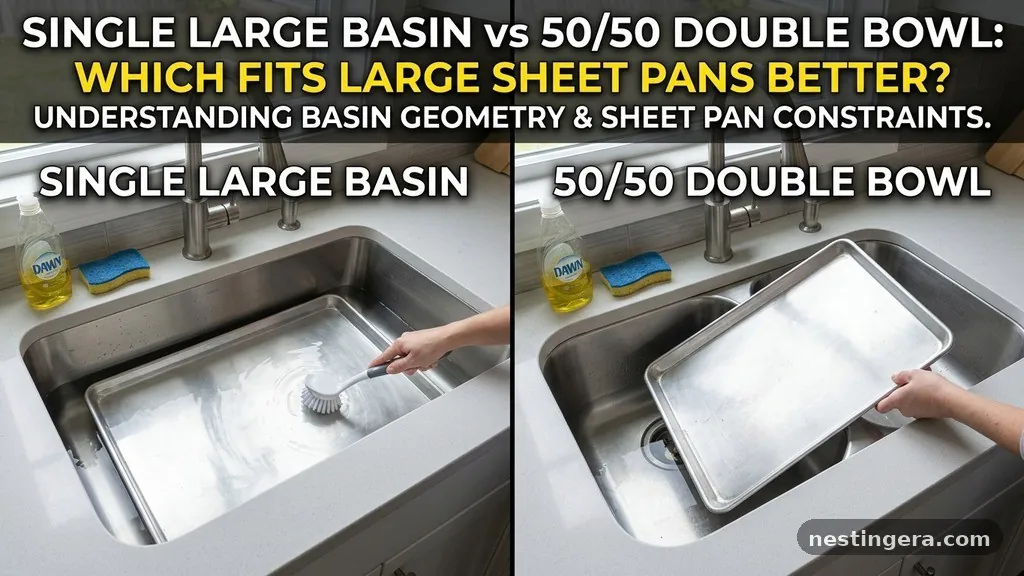
When considering the single large basin vs 50/50 double bowl debate, the winner for sheet pans is undeniably the single large basin. A single bowl sink provides an unobstructed footprint, allowing a standard half-sheet pan to lay perfectly flat against the bottom. In a 50/50 double bowl configuration, the central divider typically forces the pan to sit at an awkward angle or stay entirely above the rim.
This limitation makes soaking, scrubbing, and rinsing oversized items difficult, often leading to water splashing onto your countertops and floor. If your priority is accommodating large cookware, the single basin design offers the necessary clearance that a split sink simply cannot provide.
Understanding Basin Geometry and Sheet Pan Constraints
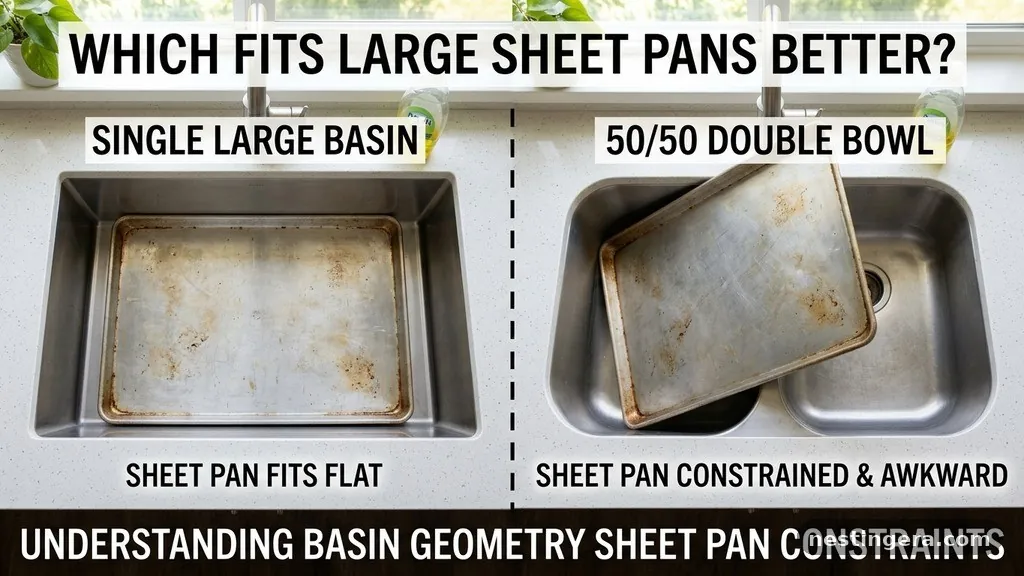
The primary reason a large single bowl outshines a double bowl for sheet pans is the absence of the central divider. A standard half-sheet pan measures approximately 18 by 13 inches, and when you add the lip, it takes up significant space.
In a 50/50 configuration, each side of the sink is usually restricted to roughly 14 to 15 inches of width. While this might seem sufficient on paper, the presence of the drain assembly and the angled walls of the basin often reduce the usable flat surface area.
When you attempt to place a large pan into a 50/50 sink, the divider acts as a physical barrier. You cannot lay the pan flat, which means you cannot effectively soak the entire surface at once. You end up scrubbing one half, flipping the pan, and then scrubbing the other, which is time-consuming and messy.
Conversely, a single large basin provides a flat, open floor that accommodates the full dimensions of the pan. This allows for total submersion, making the cleaning process significantly faster and more hygienic.
The Ergonomics of Large Basin Design
Ergonomics play a vital role in your daily kitchen experience, particularly regarding how you handle heavy items. A deep, single basin allows you to keep large sheet pans and Dutch ovens below the countertop level while you work on them.
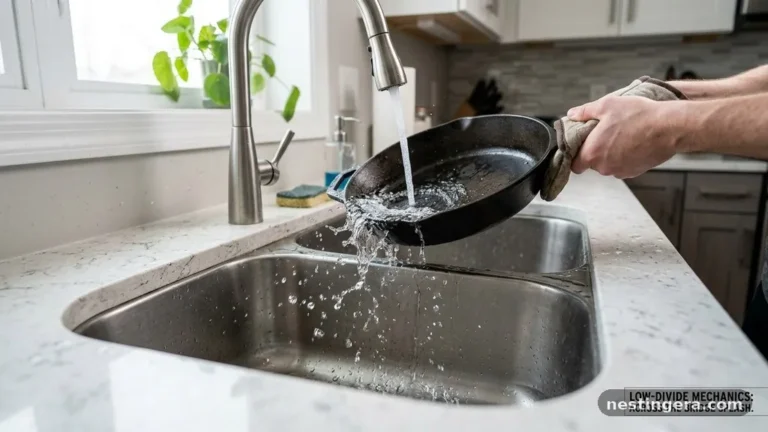
This prevents the “splash-back” effect that occurs when you try to rinse a large object that is perched high on a divider. By keeping the mess contained within the basin, you maintain a cleaner workspace and reduce the need for constant wiping.
Furthermore, a large basin allows for more natural arm positioning during heavy cleaning tasks. When you are scrubbing a large roasting pan in a cramped double sink, your elbows are often forced outward to avoid hitting the cabinetry or the other side of the sink.
A single basin provides enough room to maneuver your arms comfortably. This is particularly important for individuals with limited mobility or those who frequently deal with heavy, awkward cookware that requires significant physical effort to clean properly.
Evaluating the 50/50 Double Bowl Workflow
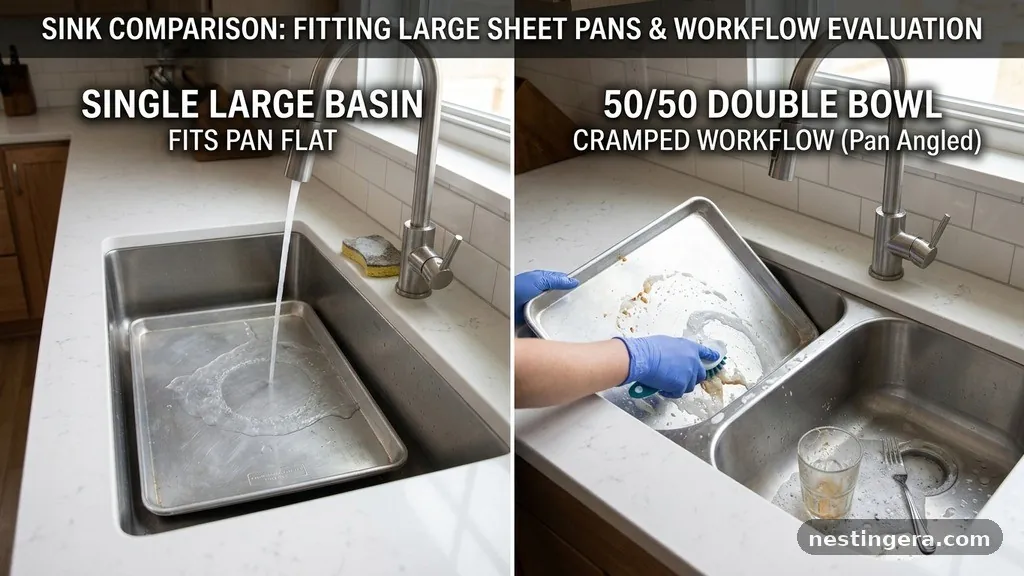
While the single basin wins on sheer capacity, the 50/50 double bowl has its own set of advantages for specific kitchen routines. Many people prefer the double bowl because it allows them to separate tasks.
You can use one side for soaking dirty dishes while keeping the other side free for rinsing produce or draining washed items. This separation is often cited as a major benefit for those who do not own a dishwasher or who prefer to hand-wash everything.
However, the 50/50 split is inherently restrictive for modern, large-scale cooking. The design assumes that kitchen tasks are small and compartmentalized. When you introduce a large sheet pan into this environment, the design fails to adapt.
You are forced to choose between leaving the pan dirty on the counter or struggling to wash it in a sink that was not designed for its size. For many modern kitchens where large-format cooking is common, the 50/50 split often feels like an outdated configuration.
Comparative Analysis of Sink Configurations
To help visualize how these two styles stack up, consider the following breakdown of functional differences. While individual models vary, these characteristics represent the standard industry experience.
| Feature | Single Large Basin | 50/50 Double Bowl |
|---|---|---|
| Sheet Pan Fit | Excellent (lies flat) | Poor (must be tilted) |
| Task Separation | Requires a basin rack | Built-in separation |
| Splash Containment | High | Low (due to divider) |
| Installation Ease | Standard | Requires two drains |
As shown in the table, the trade-off is almost always between “capacity for large items” and “convenience of separate zones.” If you choose a single basin, you can easily replicate the double bowl experience by using a removable basin rack or a plastic tub for soaking.
However, you cannot magically add space to a 50/50 double bowl when you need to wash a large pan. This makes the single basin the more flexible choice for a wide variety of kitchen needs.
The Role of Workstation Sinks
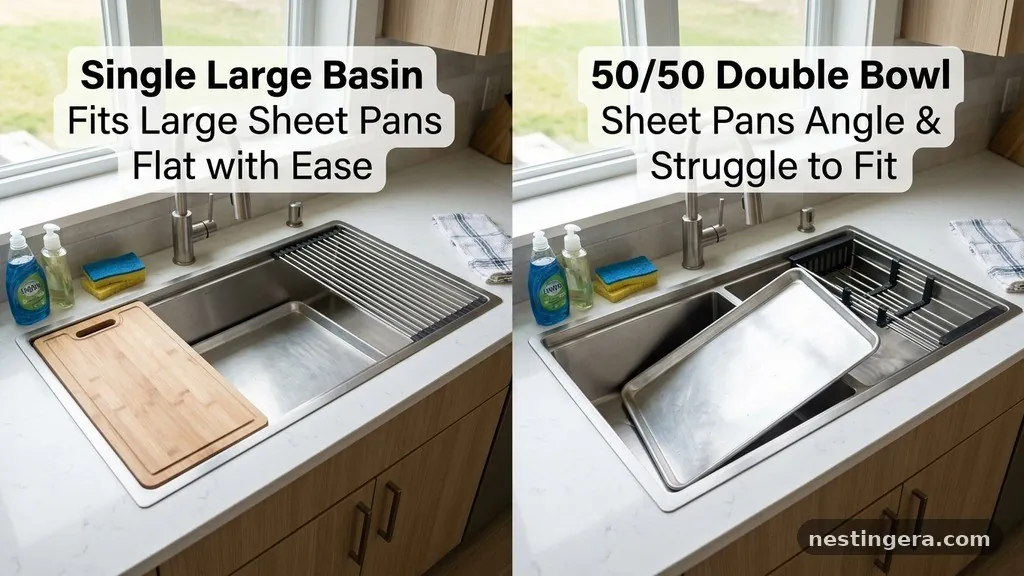
If you are worried about losing the functionality of a double bowl, consider the modern workstation sink. These are typically single large basins that include integrated ledges for accessories like cutting boards, colanders, and drying racks.
By utilizing these accessories, you can effectively create a “second bowl” whenever you need it. You can place a colander over half the sink to drain pasta while keeping the other half open for soaking.
This approach combines the best of both worlds. You retain the massive, unobstructed capacity required for sheet pans while gaining the organizational benefits of a double bowl. Many manufacturers now offer these systems with high-quality stainless steel finishes that are both durable and easy to maintain.
Investing in a workstation sink often solves the debate between the single large basin vs 50/50 double bowl by rendering the old-fashioned divider obsolete. You can read more about kitchen sink design standards to see how these dimensions impact your overall cabinet planning.
Impact of Material and Installation Type
The material you choose, such as stainless steel, fireclay, or composite granite, influences how your sink handles large items. Stainless steel is often the best choice for large basins because it is lightweight and durable.
It allows for thinner walls, which maximizes the interior volume of the basin. Thick-walled materials like fireclay or cast iron can sometimes reduce the internal dimensions of the sink, even if the exterior footprint is the same.
Installation type also matters significantly for usability. An undermount installation is ideal for large basins because it creates a flush transition from the countertop to the sink. This makes it much easier to wipe debris directly into the drain without it getting caught on a rim.
When dealing with large sheet pans, the ability to slide the pan across the counter and into the sink without hitting a lip is a major convenience. Top-mount or drop-in sinks have a rim that can obstruct the movement of large, heavy pans.
Managing Water Consumption and Cleaning
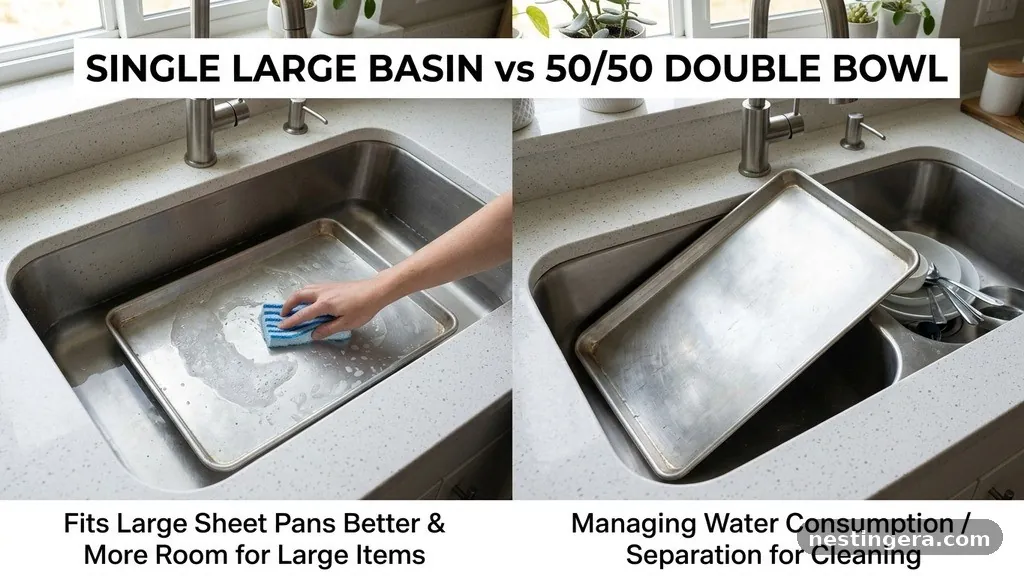
A common misconception is that a single large basin uses more water than a double bowl. In reality, you only need to fill the basin to the depth required for the specific task at hand.
If you are washing a few glasses, you don’t need to fill the entire large basin. However, if you are soaking a large sheet pan, a single basin allows you to fill only the bottom inch or two, covering the surface area without wasting gallons of water.
In a 50/50 double bowl, you are forced to fill at least one half of the sink, which might be too small for the pan, or you might find yourself filling both sides to handle a larger project. This often leads to higher water usage over time. Furthermore, cleaning a single basin is generally faster.
You have fewer corners and no central divider to wipe down, which reduces the buildup of grime and soap scum. A single basin is simply more efficient to sanitize after a heavy cooking session.
The Aesthetic and Spatial Considerations
From a design perspective, a single large basin offers a cleaner, more minimalist look. It breaks up the countertop less than a double bowl, creating a sense of continuity in your kitchen layout.
This is especially beneficial in smaller kitchens where visual clutter can make the room feel cramped. A large, deep sink can become a focal point of the kitchen, especially if it is a farmhouse-style apron-front sink.
However, you must ensure that your base cabinet can accommodate the width of a large basin. Most single bowls require a cabinet width of at least 30 to 36 inches.
If you are retrofitting an existing kitchen, you are limited by the size of the current cabinet opening. Always measure your interior cabinet space carefully before committing to a wide single basin, as you may need to modify the cabinet structure to accommodate the extra width.
Common Pitfalls When Choosing a Sink
Many homeowners make the mistake of choosing a sink based on how they think they will use it rather than how they actually use it. If you rarely hand-wash dishes, a deep double bowl might just become a storage area for dirty sponges and half-empty detergent bottles.
Be honest about your cleanup habits. If you use a dishwasher for 90% of your dishes, a single large basin is almost always the superior choice for those occasional, hand-washed items like sheet pans and large pots.
Another pitfall is ignoring the depth of the sink. A wide sink is only useful if it is also deep enough to contain the spray from your faucet. Look for a depth of at least 9 to 10 inches.
This depth provides enough room to submerge large items fully and keeps the water contained, even when the faucet is running at full pressure. A shallow, wide sink will result in water splashing onto your backsplash and floor, regardless of how many bowls it has.
Frequently Asked Questions
Is a single large basin harder to keep clean than a double bowl?
Generally, a single large basin is easier to clean because it lacks the central divider, which is a notorious spot for grime and mineral buildup. With only one set of corners and no divider to scrub around, you can wipe the entire surface in seconds. The only extra effort involved is cleaning the larger surface area, but the lack of obstructions makes this much faster than cleaning a double bowl.
Can I wash delicate items in a single large basin without a divider?
Yes, you can easily use a plastic wash basin or a drying rack that sits inside the sink to create a dedicated area for delicate items. Many modern sinks come with custom-fit accessories that allow you to partition the space as needed. This modular approach gives you the flexibility of a double bowl when you need it, without sacrificing the capacity for large sheet pans.
Do I need a special faucet for a large single basin?
While you don’t need a special faucet, a pull-down sprayer is highly recommended for large single basins. Because the sink is wide, you need a way to rinse the corners effectively without splashing water everywhere. A pull-down sprayer allows you to direct the water precisely where it is needed, making it much easier to clean large items and wash away food debris from the edges of the sink.
Will a large single basin fit into a standard 30-inch cabinet?
It depends on the specific model, but many manufacturers offer “apron-front” or “undermount” sinks designed specifically to fit into a 30-inch cabinet. You must check the interior dimensions and the required cabinet clearance provided by the manufacturer. If your cabinet is exactly 30 inches, you may have limited options, but you can typically find a high-quality single bowl that maximizes that space.
Is the 50/50 double bowl completely obsolete?
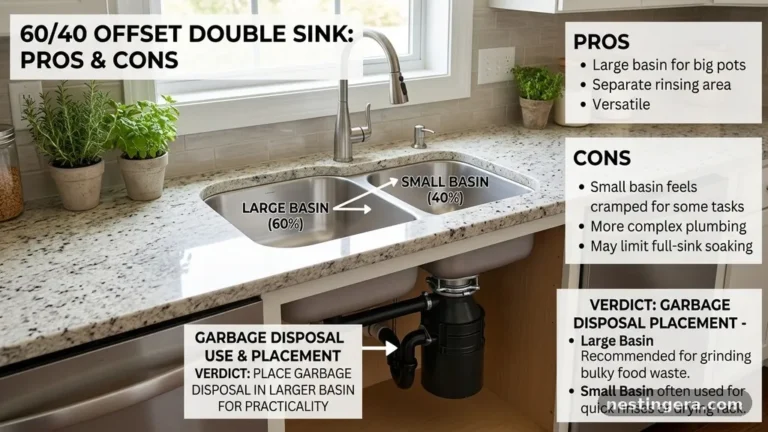
Not at all, as it remains a popular choice for people who do not use a dishwasher and prefer to have a dedicated “soak” side and a “rinse” side. It is a matter of personal preference and workflow. However, for those who prioritize the ability to clean large cookware like sheet pans, the 50/50 split is often considered less functional than a single large basin or a 60/40 offset bowl.
Final Thoughts on Your Sink Selection
Selecting the right sink is a long-term investment in your kitchen’s functionality. If you frequently find yourself struggling to clean large sheet pans, the evidence strongly points toward a single large basin as the more practical solution.
By removing the divider, you gain the freedom to soak and scrub your largest cookware without the frustration of awkward angles or splash-prone edges. While the 50/50 double bowl offers a traditional sense of separation, it rarely satisfies the needs of a modern home cook who uses full-sized pans.
Evaluate your specific needs by considering how often you hand-wash versus using a dishwasher. If you want the best of both worlds, look into workstation sinks that offer the capacity of a single bowl with the organizational benefits of integrated accessories.
Taking the time to measure your cabinet space and choosing a high-quality material will ensure that your new sink serves you well for years to come. Whether you opt for a deep farmhouse style or a sleek undermount, focusing on usable, unobstructed space will ultimately make your kitchen time more efficient and enjoyable.